
About Us
Dedicated to Preserving History
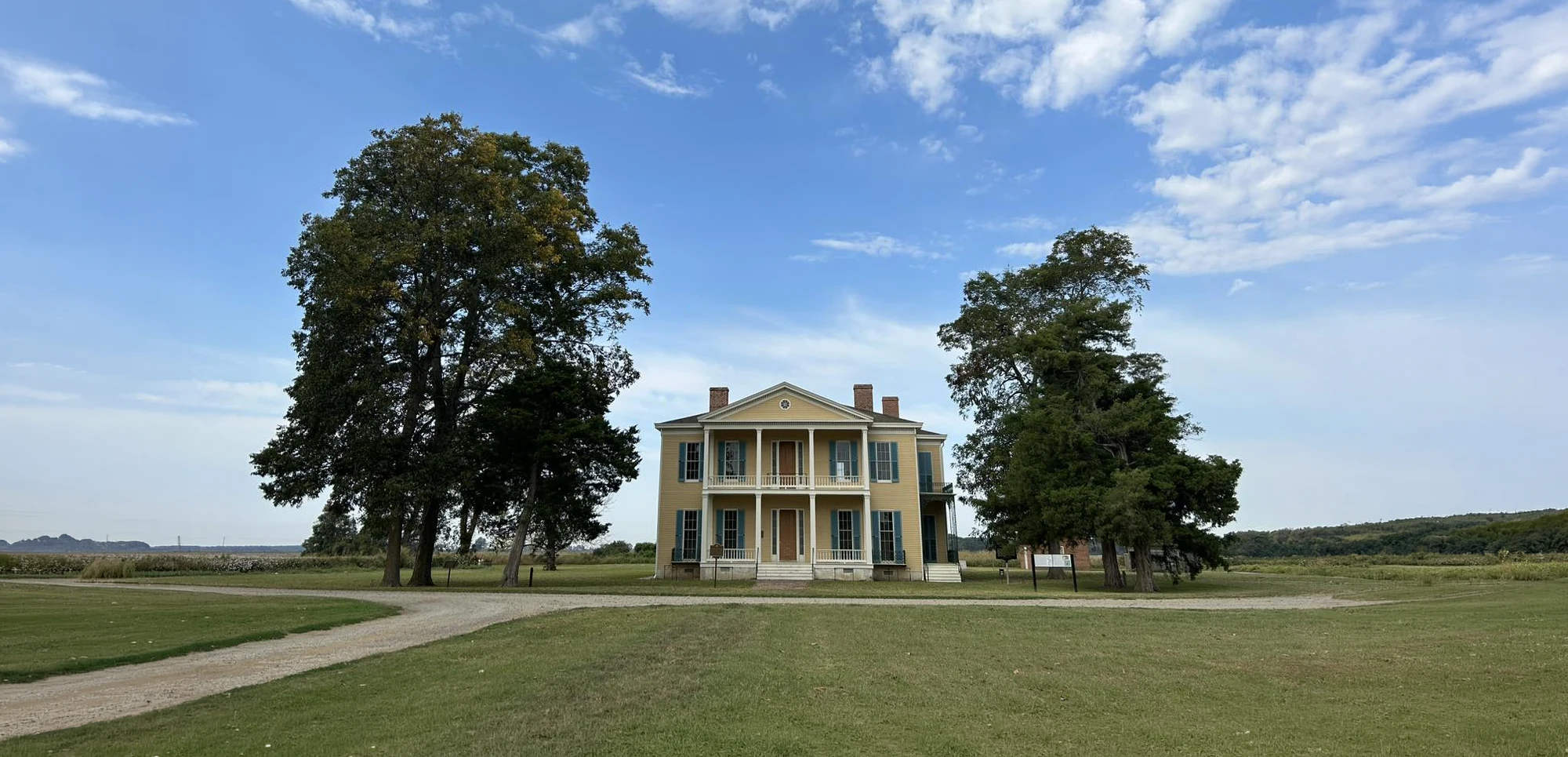
Over the years, the name Lakeport has referred to several places and features in the Arkansas Delta. On a contemporary highway map, Lakeport appears near the Mississippi River just south of U.S. Highway 82 at the end of Highway 142. This location marks the site of a former steamboat landing, where thousands of bales of cotton were shipped downriver to New Orleans.
On earlier maps, the name Lakeport referred to a large plantation established before the Civil War by Joel Johnson of Kentucky.
Later, the name became associated with the plantation house built in 1859 for Joel Johnson’s son, Lycurgus, and his wife, Lydia Taylor Johnson. Their descendants lived in the house until it was sold to Sam Epstein in 1927.
The Lakeport Plantation Museum house is the only remaining plantation home in Arkansas located on the Mississippi River. Today, visitors can tour the site thanks to a 2001 gift to Arkansas State University from the Sam Epstein Angel family.
The restoration of Lakeport Plantation Museum into a public historic site has been supported through grants from the Arkansas Natural and Cultural Resources Council, the National Endowment for the Humanities, and the Save America’s Treasures program.
Our Mission
The Lakeport Plantation Museum researches and interprets the people and cultures that shaped plantation life in the Mississippi River Delta, focusing on the Antebellum, Civil War, and Reconstruction periods. Our mission includes teaching the methods by which we know, develop and remember these stories.
Our Background
The Lakeport Plantation Museum house was placed on the National Historic Register in 1974 and was designated in 2002 as an official project of the Save America’s Treasures program through the National Park Service and the National Trust for Historic Preservation.
The Plantation has remained in continuous cotton production since the 1830s when slaves carved it from the heavily forested Arkansas frontier. Thus, it provides complete documentation of agricultural development in the region and the accompanying changes in the African American experience. These include the transition from frontier and plantation slavery, to sharecropper and tenant farmer systems, to agricultural mechanization and the resultant mass exodus of African Americans to factories in the North, to large-scale corporate farming.
Arkansas State University operates the site as a museum and educational center, with the house itself as a primary artifact. It is the philosophy of the Restoration Team (and endorsed by the university) that furnished houses have been done well in other places. Rather than create another “pretty house,” or one in which representative furnishings substitute for the original, this restoration and interpretation focuses on the lifestyles and relationships between the people who lived and worked at Lakeport—as slaves and masters, as tenant farmers and land owners.
Through exhibits and ongoing programming, visitors and scholars will develop greater understanding of themes including (1) the westward push for new agricultural lands, (2) the pivotal role of African-Americans in the agricultural development of the region and in shaping the culture that exists today, (3) the differences and similarities in plantation architecture and lifestyles between the Arkansas Delta and other Delta and southern states, (4) the skills, techniques and issues involved in preservation of historic structures, and (5) the ongoing struggle to harness the river, clear the swamps, and convert land to agricultural production.
Research Projects at the Lakeport Plantation Museum
Along with research to assist in the actual restoration of the Lakeport Plantation Museum, Arkansas State University and the Research Team have conducted ongoing projects to understand the people who lived and worked at Lakeport and their contributions to shaping the culture of the region. Major research is being conducted in the following areas.
Archaeological surveys have been completed prior to proceeding with each phase of restoration work at the Lakeport Plantation Museum.
Remote sensing has been done in areas surrounding the main house (where many of the outbuildings were located), as well as in one of the African-American cemeteries on site. Additionally, dendrochronology testing was done to determine the age of the main house and an adjacent log structure.
For a general overview of the historical archaeology at the Lakeport Plantation Museum visit the UA-Winthrop Rockefeller Institute Archeological Station’s page on Plantations in Arkansas. The page includes a 1984 sketch of Lakeport’s layout, including outbuildings, by archaeologist Skip Stewart-Abernathy.
Genealogy-related research is being conducted to assist in understanding the Johnson family and the lifestyles at the Lakeport Plantation.
While no diaries or memoirs have been located for the immediate family at Lakeport, such documents have located for relatives and associates. Deed and Probate records, census records, marriage and death records, cemetery records, family Bibles, family genealogy books, and other family documents also have been examined and copied.
Research is underway for the families of former enslaved people of Lakeport.
In addition to the sources utilized in other genealogical research, this team is looking at documents on slave transactions, newspaper articles on run-aways, family interviews, slave narratives, and other related sources. Reports have been prepared by A-State graduate students on slave cemeteries, burial customs, and the process of clothing the enslaved workers of Lakeport.
Oral history interviews with individuals associated with the Lakeport Plantation (including family members, plantation workers, and descendants of slaves and sharecroppers) are being conducted. To date, more than 75 individuals have been interviewed.
Lakeport Resources & Restoration
Documenting the restoration of the Lakeport Plantation Museum is an essential part of the restoration process. Documentation and summaries of some of the restoration work are provided below.
Technical Reports
Much of the technical work for the restoration was documented and complied into technical reports.
Selected Published References
- Arkansas Department of Planning. Arkansas Natural Area Plan (Little Rock: Arkansas Department of Planning, 1974).
- Arnold, Morris S. Colonial Arkansas 1686-1804 (Fayetteville: University of Arkansas Press, 1991).
- Arnold, Morris S. Law Unto This Savage Race: European Legal Traditions in Arkansas, 1686-1804 (Fayetteville: University of Arkansas Press, 1985).
- Arnold, Morris S. The Rumble of a Distant Drum. Fayetteville: University of Arkansas Press, 2000.
- Ashmore, Harry S. Arkansas: A History. New York: W. W. Norton & Company, 1984.
- Baird, W. David. The Quapaw Indians: A History of the Downstream People. Norman: University of Oklahoma Press, 1980.
- Bakeless, John. America as Seen by its First Explorers. New York: Dover Publications, 1989.
- Barry, John M. Rising Tide. The Great Mississippi Flood of 1927 and How it Changed America. New York: Simon and Schuster, 1997.
- Baskett, Tom, Jr., ed. The Arkansas Delta: A Landscape of Change. Helena: Delta Cultural Center, 1990.
- Bennett, Swannee and William B. Worthen. Arkansas Made: A Survey of the Decorative, Mechanical, and Fine Arts Produced in Arkansas, 1819 – 1870. Fayetteville: University of Arkansas Press, 1990.
- Bevins, Ann Bolton. A History of Scott County as Told by Selected Buildings. Georgetown, KY: Ann Bolton Bevin, 1981.
- Bevins, Ann Bolton. The Ward and Johnson Families of Central Kentucky and The Lower Mississippi Valley. Georgetown, KY: Ward Hall Press, 1984.
- Bolsterli, Margaret J., ed. A Remembrance of Eden. Fayetteville: University of Arkansas Press., 1993.
- Bolton, Herbert E. Athanase de Mezieres and the Loisiana-Texas Frontier 1768-1780. (New York: Kraus Reprint Co., 1970.
- Bolton, S. Charles. Territorial Ambition: Land and Society in Arkansas 1800-1840. Fayetteville: University of Arkansas Press., 1993.
- Bolton, S. Charles. Arkansas, 1800-1860: Remote and Restless. Fayetteville: University of Arkansas Press, 1998.
- Bolton, S. Charles. Fugitives from Injustice: Freedom-Seeking Slaves in Arkansas, 1800-1860. National Park Service: Historic Research Study, 2006.
- Christ, Mark K., ed. Rugged and Sublime. Fayetteville: University of Arkansas Press, 1994.
- Cramer, Zadok. The Navigator. Pittsburg: Cramer, Spear and Eichbaum, 1814.
- Crocker, Mary Wallace. Historic Architecture in Mississippi. Jackson: University Press of Mississippi, 1977.
- DeBlack, Thomas A. “A Garden in the Wilderness: The Johnsons and the Making of Lakeport Plantation, 1831-1876.” PhD dissertation, University of Arkansas, 1995.
- DeBlack, Thomas A. “Lakeport: Showplace of Arkansas ‘Cotton Aristocracy’,” In Sentinels of History, ed. Mark K. Christ and Cathryn H. Slater. Fayetteville: University of Arkansas Press, 2000.
- DeBlack, Thomas A. With Fire and Sword: Arkansas, 1861-1874. Fayetteville: The University of Arkansas, 2003.
- DeBlack, Thomas A. “’A Model Man of Chicot County’”: Lycurgus Johnson and Social Change.” In The Southern Elite and Social Change: Essays in Honor of Willard B. Gatewood Jr., Randy Finley and Thomas A DeBlack, eds. Fayetteville: University of Arkansas Press, 2002.
- Deetz, James. In Small Things Forgotten. New York: Doubleday, 1996.
- Dillard, Tom and Valerie Thwing. Researching Arkansas History. A Beginner’s Guide. Little Rock: Rose, 1979.
- Dougan, Michael B. Arkansas Odyssey. Little Rock: Rose, 1994.
- Eichstedt, Jennifer L. and Stephen Small. Representations of Slavery: Race and Ideology in Southern Plantation Museums. Washington, D.C.: Smithsonian Press, 2002.
- Finley, Randy. From Slavery to Uncertain Freedom. The Freedmen’s Bureau in Arkansas, 1856-1869. Fayetteville: University of Arkansas Press, 1996.
- Foster, Lynn. “Their Price and Ornament: Judge Benjamin Johnson and the Federal Courts in Early Arkansas,” University of Arkansas Law Review 21 (Fall 1999): 21-48.
- Foti, Thomas. “The River’s Gifts and Curses,” in The Arkansas Delta, ed. Jeannie M. Whayne and William B. Gatewood. Fayetteville: University of Arkansas Press, 1993.
- Fountain, Sarah M., ed. Authentic Voices: Arkansas Culture, 1541-1860. Conway: University of Central Arkansas Press, 1986.
- Fox-Genovese, Elizabeth. Within the Plantation Household. (Chapel Hill: University of North Carolina Press, 1988.
- Franklin, John H. and Loren Schweninger. Runaway Slaves. Oxford: Oxford University Press, 1999.
- Garvin, James. A Building History of Northern New England. Hanover, NH: University Press of New England, 2001.
- Gatewood, Willard B. “Sunnyside: The Evolution of an Arkansas Plantation,” In Shadows over Sunnyside, ed. Jeannie Whayne. Fayetteville: University of Arkansas Press, 1993.
- Genovese, Eugene D. Roll, Jordan, Roll: The World the Slaves Made. New York: Vintage Books, 1976.
- Goodspeed Publishing Company. Biographical and Historical Memoirs of Southern Arkansas. Chicago, Nashville and St. Louis: The Goodspeed Publishing Co., 1890.
- Gordon, Fon Louise. Caste Class: The Black Experience in Arkansas, 1880 – 1920. Athens: University of Georgia Press, 1995.
- Gerald T. Hansan and Carl H. Moneyhon. Historical Atlas of Arkansas. Norman: University of Oklahoma Press, 1989.
- Hempstead, Fay. A Pictorial History of Arkansas from Earliest Times to the Year 1890. St. Louis and New York: N. D. Thompson Publishing Co., 1890.
- Hudson, Charles. The Southeastern Indians. Knoxville: University of Tennessee Press, Tennessee, 1986.
- Hunter, Louis C. Steamboats on the Western Rivers: An Economic and Technological History. New York: Dover Publications, 1993.
- Jones, J. Wayne. “Chicot Blue Grass: The Isaac H. Hilliard Plantation, 1844-1890,” The Ozark Historical Review 28, (1999).
- Kemblem, Frances Anne. Journal of a Residence on a Georgian Plantation in 1838-1839. Athens: University of Georgia Press, 1984.
- Kester, Howard. Revolt among the Sharecroppers. Knoxville: University of Tennessee Press, 1997.
- Lancaster, Bob. The Jungles of Arkansas: A Personal History of the Wonder State. Fayetteville: University of Arkansas Press, 1989.
- Lancaster, Clay. Antebellum Architecture of Kentucky. Lexington: University of Kentucky Press, 1991.
- Moneyhon, Carl H. Arkansas and the New South, 1874-1929. Fayetteville: University of Arkansas Press, 1997.
- Moore, Dwight M. Trees of Arkansas, 4th Edition. Little Rock: Arkansas Forestry Commission, 1996.
- Parks, Bonnie. “The History and Technology of Floorcloths,” APT Bulletin 21 (1989): 44-54.
- Saucier, Roger T. Geomorphology and Quaternary Geologic History of the Lower Mississippi Valley. Vicksburg: U.S. Army Engineer Waterways Experiment Station, 1994.
- Sealander, John A. and Gary A. Heidt. Arkansas Mammals: Their Natural History, Classification, and Distribution. Little Rock: Arkansas Game and Fish Commission, 1990.
- Sherrard, Robert A. and Thomas J. Sherrard. The Sherrard Family of Steubenville. Philadelphia: James B. Rogers, 1890.
- Simons, Don. R. In Their Words: A Chronology of the Civil War in Chicot County, Arkansas and Adjacent Waters of the Mississippi River. Sulphur: Wise Publications, 1999.
- Smith, Richard M. The Atlas of Arkansas. Fayetteville: University of Arkansas Press, 1989.
- Story, Kenneth. “A Jewel of the Delta. Lakeport Plantation,” Newsletter of the Historic Preservation Alliance of Arkansas 9:1 (1990).
- Sutton, Keith, ed. Arkansas Wildlife: A History. Fayetteville: University of Arkansas Press, 1998.
- Swearingen, Gordon J. History of the Soil and Water Conservation District Movement in Arkansas. Arkansas Association of Conservation Districts, 1970.
- Taylor, Orville W. Negro Slavery in Arkansas. 1958. Reprint, Fayetteville: University of Arkansas Press, 2000.
- Thomas, Cyrus. Report on the Mound Explorations of the Bureau of Ethnology. Washington, D. C.: Smithsonian Institution Press, 1985.
- Twain, Mark, Life on the Mississippi. New York: Penguin Books, 1986.
- Usner, Daniel H., Jr. Indians, Settlers, and Slaves in A Frontier Exchange Economy. Chapel Hill: University of North Carolina Press, 1992.
- Vlach, John M. Back of the Big House: The Architecture of Plantation Slavery. Chapel Hill: University of North Carolina Press, 1993.
- Whayne, Jeannie M., ed. Shadows over Sunnyside: An Arkansas Plantation in Transition, 1830-1945. Fayetteville: University of Arkansas Press, 1993.
- Whayne, Jeannie M. and Williard B. Gatewood, eds. The Arkansas Delta: Land of Paradox. Fayetteville: University of Arkansas Press, 1993.
- White, Deborah G. Ain’t I a Woman? Female Slaves in the Plantation South, revised ed. New York: W. W. Norton, 1999.
- Woods, James M. Rebellion and Realignment: Arkansas’s Road to Secession. Fayetteville: University of Arkansas Press, 1987.
- Work Projects Administration. The WPA Guide to 1930s Arkansas, with a New Introduction by Elliott West. Lawrence: University Press of Kansas, 1987.
- Wintory, Blake. “The House that Cotton Built: Recovering African American History at Lakeport Plantation,” Arkansas Review: A Journal of Delta Studies 40 (August 2009): 100-104.
- Worthington, Amanda. Diary of Amanda Worthington, Unpublished Diary, Special Collections, William Percy Memorial Library, Greenville, MS.
- Zimmer, Donald T. “The Ohio River: Pathways to Settlement,” In Transportation and the Early Nation: Papers Presented at an Indiana American Revolution Bicentennial Symposium. Indianapolis: Indiana Historical Society, 1982.
- Zimmer, Donald T. “Madison, Indiana, 1811-1860: A Study in the Process of City Building.” Ph.D. dissertation, Indiana University, 1974.
The Lakeport Plantation Museum house features a state-of-the art climate control system that serves as a national Best Practices Model for historic homes. The HVAC design team was led by Ernest Conrad of Landmark Facilities Group in Norwalk, Connecticut, working with Lakeport architect Charles Witsell of WER Architects in Little Rock. Exterior components of the climate control system are quiet and invisible to visitors, with fans, pumps, compressors and other equipment located in the accurately reconstructed smokehouse.
Air for the house is conditioned from the smokehouse, with temperature or humidity modified as required, then delivered to the system’s interior components through waterproof, underground high-pressure air ducts. Rather than installing loud and unsightly chillers for cooling, the project uses a geo-thermal heat pump system of closed loop tubing buried 300 feet underground. An enclosure behind the smokehouse contains the facility’s electrical transformer and emergency generator. In the event of a power failure, the generator activates and keeps the fire protection system operating.
Lakeport’s state-of-the-art climate control system serves as a national Best Practices model for historic homes. The system is designed to maintain humidity and temperature within a close range to protect the building and its contents. Further, the intent is to give visitors an experience of “walking back in time,” with minimal noise and sight intrusions from modern equipment.
Exterior components of the system force conditioned air through underground high-pressure ducts and up to the attics, where ducts connect into the chimney flues, terminating at the 13 fireboxes. In most rooms, grills for the delivery of the controlled air are at the top rear of the fireboxes, out of the line of sight. Air is returned to the smokehouse through a register hidden under the stair, then down under the house and back to the smokehouse through the underground ductwork.
Prior to undertaking work on each damaged door at Lakeport, historic building craftsman Ronnie Walker conducted a complete assessment, then developed a restoration plan. In all cases, care was taken to retain as much of the original fabric as possible. Consolidants and wood putty were used to repair wood deterioration and damaged surfaces, repairs were made using early techniques, and missing moldings were re-created using hand tools and wood planes from the period in which the house was built. After repairs, surfaces were brought back smooth to accept re-created original faux finishes.
For 150 years Lakeport’s entry hall floorcloth provided a decorative washable surface that helped keep dirt from soiling the finer carpets beyond the entry. Common in its day, it is a rare gem in spite of much loss and wear. Few mid-nineteenth century floor cloths 26’ x 15’ have survived in situ. After much deliberation, it was divided in four sections following the areas of most loss and removed from the floor. The meticulous cleaning process by Becky Witsell of Little Rock and her Studio-Werk crew involved removal of many layers of varnish, dirt and wax and one over-painting of solid ochre paint. Both the printed upper surface and the woven substrate required consolidation. The area behind the front door and those protected by large pieces of furniture now reveal the beautiful hand printed design. Fourteen colors were used to print the pattern that imitates the look of a fine woven carpet.
The original exterior color scheme and many interior painted surfaces have been re-created based on lab analysis of 170 historic paint samples taken at Lakeport. Historic paint analysis, led by Becky Witsell of Studio-Werk in Little Rock, has allowed us to accurately match original colors to their respective locations in or on the house. It has also enabled us to follow through with the same paint techniques originally used. The historic paint techniques found at Lakeport include marbling, graining to imitate oak and rosewood, plaster walls painted in whitewash, oil and distemper, and wood trim painted with three coats of white paint followed by a glossy clear varnish glaze to create a finish resembling fine porcelain.
In some cases, mantels at Lakeport were burned or severely charred by years of hard use and intense heat from the fireboxes. Where burned areas had to be removed, only enough damaged area was cut away to accept the salvaged in-kind materials necessary to bring back the original architectural interpretation. Work was done by historic craftsman Ronnie Walker using hand tools from the period when the house was built.
Preserving Original Decorative Finishes
Part of what makes Lakeport so intriguing is the remarkable number of original and early painted surfaces that remain intact. Many of the doors and mantels still exhibit the 150- year-old work of the original unnamed mid-19th century painter. There is one door surface believed to be the work of his apprentice. The woodwork on the first floor was entirely over-painted in the 20th century. To the extent possible, manual and chemical methods have been used to reveal the original work. Damage to the original work caused by abuse has been repaired. When it was obvious that loss to the original surface was caused by use and wear, the surface has been left worn.
Recreating Original Decorative Finishes
The Lakeport restoration team has sought to interpret Lakeport as a site that has evolved – not one frozen in time. Original painted surfaces have been re-created or reproduced only where they have not survived or were found to be damaged beyond reasonable restoration. In those cases the work to be re-created has been carefully studied, documented and then reproduced in the spirit of the original samples. The goal in re-creating painted surfaces is to illustrate the same quality of finish and refinement the Johnsons intended for their Arkansas home.
When restoration began on the Lakeport Plantation Museum house, the rose window that once adorned the front porch pediment was painted over and damaged to the point that it was hardly noticeable. Climbing into the attic, facilities manager Ronnie Walker found the original glass from the window, along with the scalloped wood sash. He began the process of bringing it back to its former beauty by deconstructing what remained, then using Abatron filler and Dutchmen to restore the original frame. A new rose center and muntins were designed and constructed to complete the restoration. This restoration was undertaken using the same tools and techniques that would have been used to created the window 150 years ago.
The smokehouse was one of the most important outbuildings because it was used to preserve and store the hundreds of pounds of smoked pork that served as the principal source of meat on the plantation. This original smokehouse stood until the mid-1980s, but it was a pile of rubble by 2001 when restoration began on the main house. Archeology revealed the details of the original building including the stepped-out foundation. Based on photographic and archeological evidence, the smokehouse exterior was re-created. The interior houses the high-tech mechanical system for the main house, including heating, ventilation, air-conditioning, dehumidifying, and fire suppression equipment.