
History
About the Museum
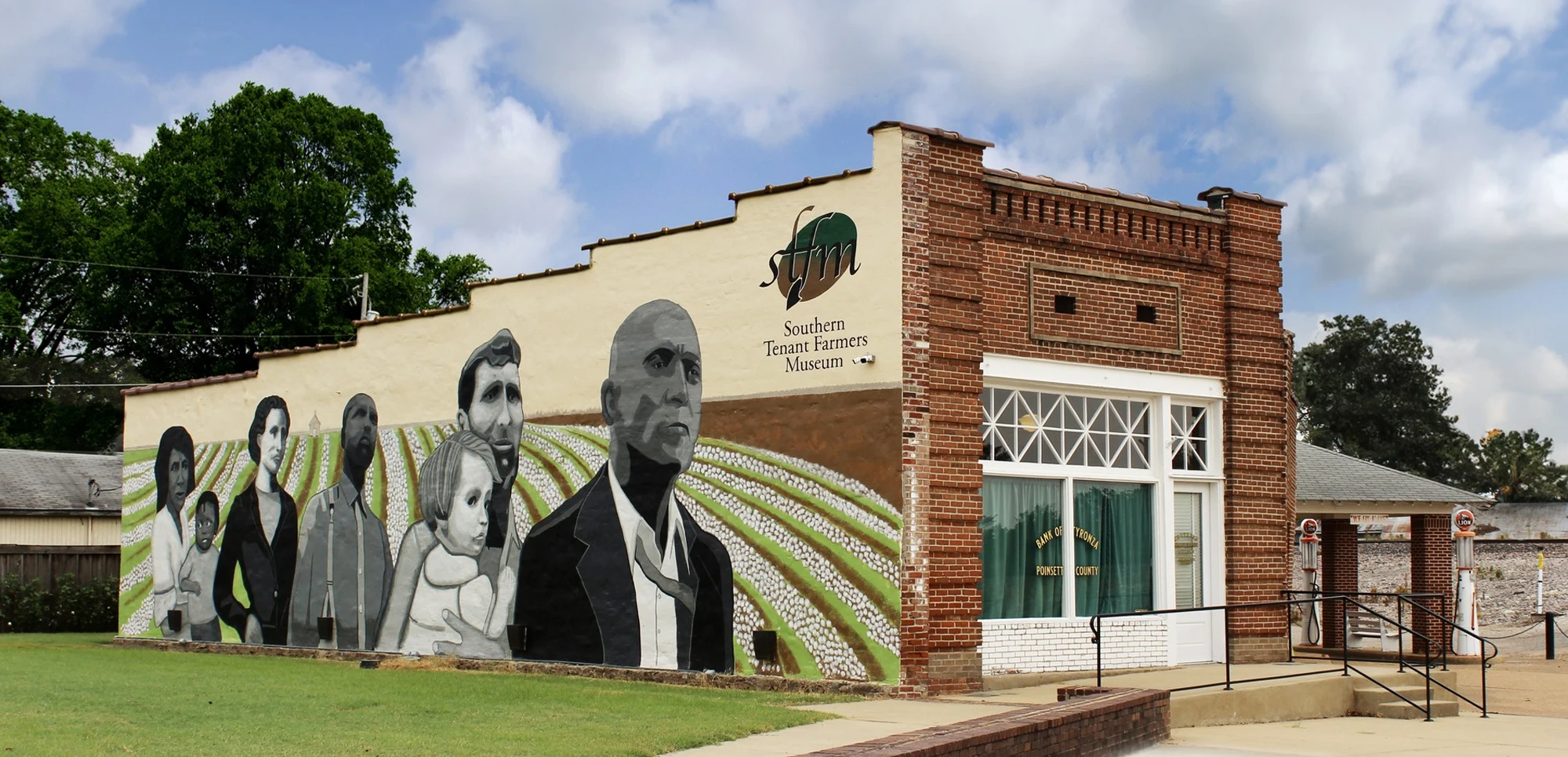
The Southern Tenant Farmers Museum opened in 2006 in the historic Mitchell-East Building in Tyronza, Arkansas.
During the 1930s, this building housed the dry cleaning business of H. L. Mitchell and the service station of Clay East, two of the organizers of the Southern Tenant Farmers Union in 1934, serving as the unofficial headquarters for the union until offices were moved to Memphis for safety.
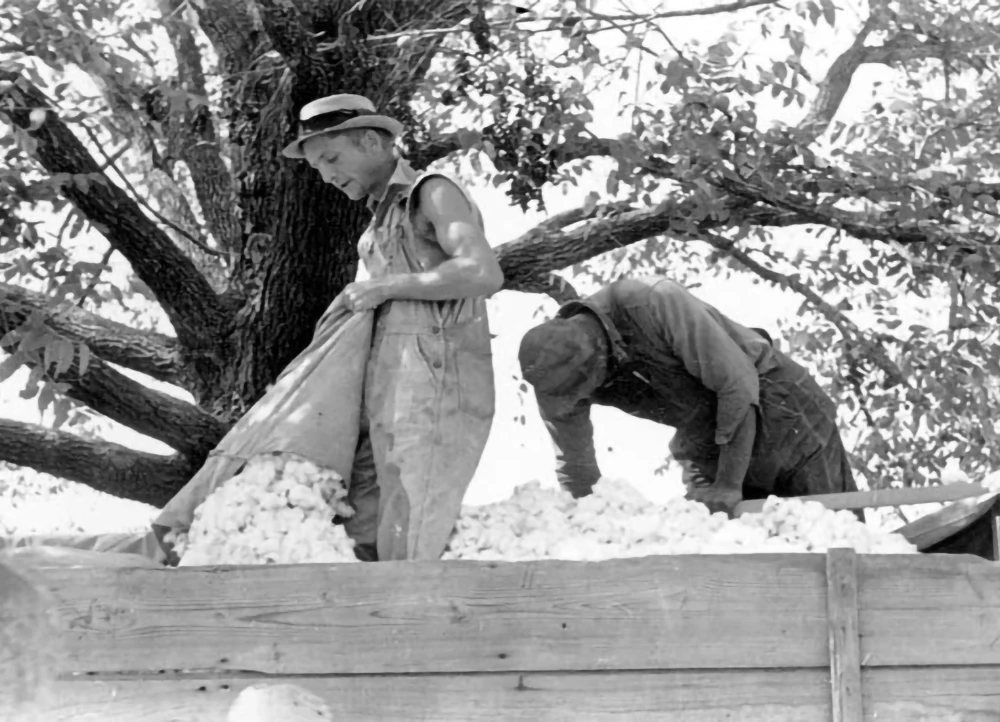
Museum exhibits, located in the Mitchell-East Building, focus on the farm labor movement in the South and the tenant farming and sharecropping system of agriculture.
The museum also includes the adjacent historic Tyronza Bank building. Facades of the bank and the Mitchell-East Building have been restored to their 1930s appearance, while the bank interior has been modified to include a reception area, gift shop, office and classroom.
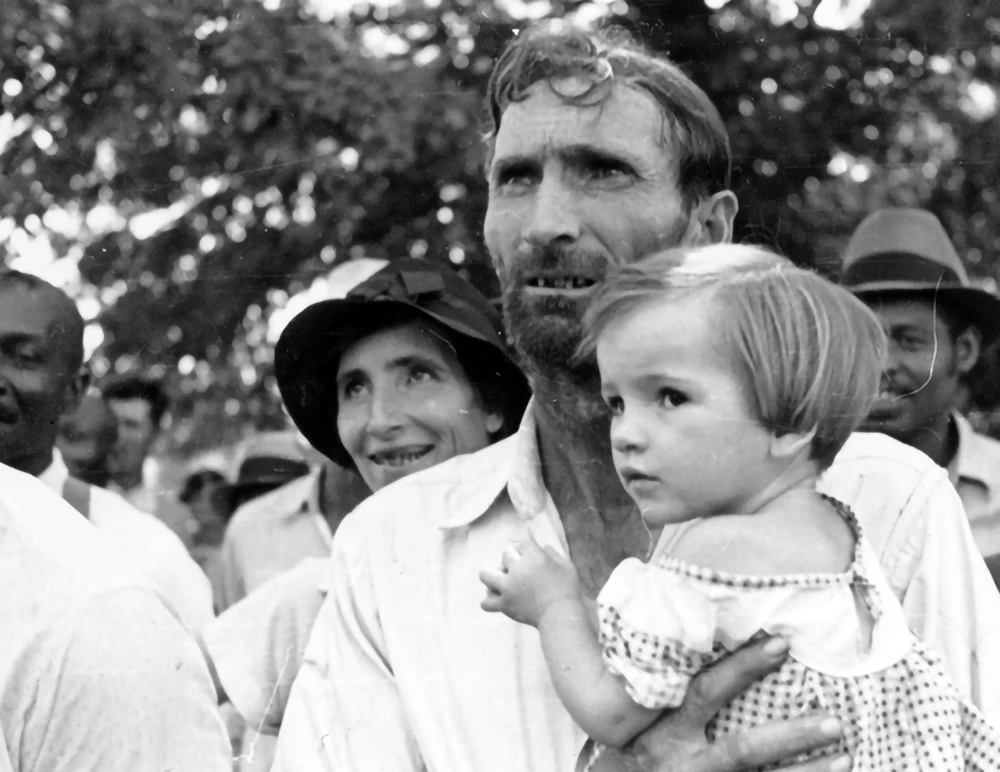
Stories are told through historic photographs, artifacts related to tenant farming, oral history excerpts, 1930s news reel footage, and interactive exhibits featuring union songs, poems, and interviews with former union leaders.
Historical Timeline
The Agricultural Wheel
- The Arkansas Agricultural Wheel reached a peak membership by 1888 of 1,947 subordinate Wheels representing every county in the state, for a total of over 75,000 members. Although the Agricultural Wheel failed to gain much for farmers in Arkansas’s political arena, the group made a big difference in the lives of Arkansas farmers, both socially and economically. The local monthly meetings broke the monotony of farm work and made the previously isolated farmers feel that they were an important part of society. The meetings also had programs on literary topics and on the issues that affected farmers in politics. The Wheel also sponsored educational programs to help farmers achieve a higher level of productivity.
Elane Race Riot of 1919
Released
- On 1/14/25, Gov. Thomas McRae ordered the release of the remaining defendants granting them indefinite furloughs after they pled guilty to second-degree murder. Other defendants were released. The riot marked one of the first times a federal court intervened against a racially biased southern court.
- With race riots in over 350 cities throughout the country in 1919, the Elaine, Arkansas
riot was a pivotal event because it typified the conditions of blacks in the United
States after World War I. The riot illustrates the inequities of the sharecropping
system and the extreme racism that was rampant in the American South.
Flood of 1927
- The Flood of 1927 was the most destructive and costly flood in Arkansas history and one of the worst in the history of the nation.
- In largely agrarian Arkansas, the Flood of 1927 covered about 6,600 square miles,
with thirty-six out of seventy-five Arkansas counties under water up to thirty feet
deep in places. Through the modern communications of the day, such as radio, the Flood
of 1927 drew national attention to the plight of sharecroppers, black and white.
H.L. Mitchell (1906-1989)
- Harry Leland "H.L." Mitchell was the son of James Young Mitchell, a tenant farmer and preacher in Halls, TN. Mitchell moved to AR in 1928 after his father suggested that he take over the clothes-pressing machine in his barbershop, later prospering the dry-cleaning business.
- Mitchell developed a close friendship with Clay East, owner of a gas station in Tyronza.
East devised a plan for the businesses to stagger the days they were open, so each
only operated two days a week plus Saturday. Mitchell told his friend the plan had
merit and was a good socialist idea.
H. Clay East (1900-1993)
- The son of a farmer and store merchant, Clay East returned to Tyronza to operate Lion gasoline station after attending Gulf Coast Military School. In 1932 he was elected township constable and named deputy sheriff.
- East co-founded the Southern Tenant Farmers Union with his friend, H.L. Mitchell in
Tyronza, Arkansas in 1934. After serving as the STFU president for a short period,
East left the union in 1937 and moved to Arizona. During World War II, he helped organize
a union at an aircraft plant in Phoenix. East spent the next 30 years operating gasoline
stations and grocery stores in Arizona until his retirement in the early 1970's.
The Great Depression
- The Great Depression began in August 1929, when the United States economy first went into an economic recession.
- Although the country spent two months with declining GDP, it was not until the Wall Street Crash of October, 1929 that the effects of a declining economy were felt, and a major worldwide economic downturn ensued. The Wall Street Crash of 1929, also known as Black Tuesday or the Stock Market Crash of 1929 was the most devastating stock market crash in the history of the United States.
Bank of Tyronza Falls
- The region was pulled into national crises when the New York Stock Exchange crashed on October 29, 1929. A severe drought in 1930 resulted in it being called "the year of no cotton." On November 19, 1930, John Emrich's Bank of Tyronza closed its doors.
- John Emrich used his own accumulated wealth to pay back all of the bank’s customers
who had lost money within a year and half. Small farms were lost to back taxes and
by the early 1930s, 80% of the land farmed in the Delta was done so by sharecroppers
and tenant farmers.
Drought
- The region experienced a drought in 1931, the worst on record for Arkansas. The state had its own financial problems and could offer little to farmers facing starvation.
- The drought left many farmers unable to feed their families. On 1/3/31 50 farmers
converged on England, AR demanding food from the Red Cross. When the crowd grew to
500, merchants agreed to open their doors and offer all they had to avert any violence.
On 1/23/31, after reading about the riot in a paper in CA, Will Rogers visited the
town, meeting with representatives of the Red Cross, the mayor, and farmers. The week
before, he had appealed to President Herbert Hoover in Washington DC for federal aid
but was turned away. He decided to raise money himself by embarking on a tour for
drought relief. The tour, along with money sent in from citizens across the country,
helped feed and clothe the people of England.
Tyronza Socialist Party Organized
- Tyronza residents, Harry Leland Mitchel and Alvin Nunally, applied for and received a charter in 1931 to organize a chapter of the Socialist Party.
- The Tyronza Socialist Party was the first in the state and one of the first in the
South.
Arkansas Socialist Party Convention
- The Arkansas Socialist Party Convention was held in a big tent on the ball field in Tyronza with Norman Thomas, candidate for President of the United States in 1932 as the featured speaker.
- Local residents began to refer to the corner of Main Street and Highway 63 where East
and Mitchell had their businesses as “Red Square” due to their socialist beliefs.
Election of President Franklin Roosevelt
- The election of President Franklin Roosevelt in 1932 brought hope for the suffering counties in the Mississippi River Delta.
- New and progressive relief programs began within weeks of Roosevelt’s inauguration.
The Agricultural Adjustment Administration, or AAA, evoked a major institutional change
to the farming process.
The New Deal
- In response to the Great Depression, a series of domestic programs focused on relief, recovery, and reform, were enacted between 1933 and 1936 via laws passed by Congress and executive orders of President Franklin D. Roosevelt.
- Many of these programs focused on assisting farmers, as Roosevelt believed that farming
must be prosperous for true prosperity to return to America.
Agricultural Adjustment Act
- The Agricultural Adjustment Act of the New Deal offered subsidy payments to farmers for plowing up part of their cotton.
- The AAA plan required all farmers to plow under every third row of their crop in order
to increase the price by decreasing the supply. The farmers were compensated with
a check from the federal government. While the AAA program worked well in much of
the country, for the landless farmers of the Delta it was devastating. The compensation
checks from the government were sent to the landowners who were expected to pass the
money along to the farm families, though that rarely happened.
Eviction
- When Hiram Norcross, one of Tyronza's largest landowners, threw 23 families of sharecroppers and their belongings out of their homes and onto the side of the road, Mitchell and East started an effort to expose the trouble with the relief program and to convince the AAA officials to enact badly-needed changes.
- Mitchell and East joined with a Memphis physiology professor and Norman Thomas, a
former presidential candidate, to publish a pamphlet, The Plight of the Share-Cropper.
Southern Tenant Farmers Union
- To secure the sharecroppers' rightful portion of the AAA payments, the Southern Tenant Farmers Union (STFU) was established just outside of Tyronza on July 18, 1934, in a small schoolhouse by eighteen men, seven black and eleven white.
- Mitchell and East were asked to help organize the union. The Mitchell-East building
served as unofficial headquarters for the union during its formative period. The union
grew into a national organization and was a forerunner of later labor and civil rights
movements. The union achieved its peak membership during the late 1930s, when its
leadership claimed about 35,000 members in Arkansas, Missouri, Tennessee, Mississippi,
and Oklahoma.
Southern Tenant Farmers Union Moves
- The Southern Tenant Farmers Union moved its headquarters from Mitchell-East Building in Tyronza to Memphis, TN, after threats from the night riders.
- Mitchell went on to lead migrant workers in CA in the 1950's and organize sugar-cane
workers in LA in the 1960's before moving to Montgomery, AL in 1973. Even in retirement
he continued to write newspaper columns and letters to editors about helping the small
farmer, he wrote his autobiography, Mean Things Happening In This Land, and he toured
the country each year on college lecture circuits."One thing I can say," the eighty-year-old
observed, "Since that first meeting in 1934 I've never been bored. I've been mad and
upset and all sorts of damn things but I've never been bored."
1935 Strike
- From its Memphis headquarters, STFU organized a peaceful cotton picker's strike in 1935 that resulted in an increase in pay to the pickers per pound of cotton.
- STFU membership spread into neighboring states of Mississippi, Tennessee, Texas, Louisiana,
and Oklahoma.
Myrtle Lawrence
- Myrtle Terry Lawrence was known as the most effective white female organizer in the STFU. While Mitchell referred to her as a "Tobacco Road character" for her habit of chewing tobacco, he admitted that she was an excellent organizer, sending her to the Southern Summer School for Women Industrial Workers in North Carolina in 1937.
- Lawrence befriended journalist Priscilla Robertson and photographer Louise Boyle in
North Carolina, inviting them to visit her in her home in St. Francis County. Their
ten-day visit that fall resulted in a celebrated collection of photographs illustrating
the everyday life of a sharecropping family, as well as union meetings and rallies.
In the early 1940s, Lawrence and her husband moved to Florida, where she worked for
the rest of her life as a janitor.
March of Time
- March of Time was a monthly documentary series produced by CBS from 1935 to 1951 that addressed social issues of the time.
- The 1937 August episode covered the plight of both black and white sharecroppers of
the South in The Land of Cotton: The Plight of the Sharecroppers. This documentary
was filmed in Colt, and many of the actors were locals. The film was directed by Jack
Glen and produced by James Agee.
Eleanor Roosevelt
- As secretary of the Southern Tenant Farmers Union, H.L. Mitchell was asked in 1937 to come to Washington D.C. to speak to Eleanor Roosevelt on behalf of homeless farm families.
- Mrs. Roosevelt asked the President to activate the Missouri National Guard, calling
on the public to provide food and shelter for displaced families. A delegation from
the STFU was instrumental in getting the Farm Security Administration (FSA) to begin
construction on the Delmo Labor Homes project providing homes for 600 farm families
who had previously been living on Missouri roadsides.
STFU Membership
- Southern Tenant Farmers Union claimed a membership of over 30,000 members in south and southwestern states.
- On the strength of their success during WWII in organizing and implementing their
migrant farmer worker programs, the Southern Tenant Farmers Union was asked to become
an associate union with the American Federation of Labor (AFL). The AFL, the largest
labor union at the time would later join with other unions to form the AFL-CIO.
Flood of 1937
- Excessive rain in the upper Mississippi and Ohio River in January 1937 resulted in another significant flooding event in these river basins. Frozen ground contributed to the runoff into the rivers. Rain was reported for 27 out of 31 days during January.
- On January 21, the U. S. Army Corps of Engineers announced that it would deliberately
breach the levee that protected the richest cotton land in the Missouri Bootheel to
relieve pressure on levees around the city of Cairo, Illinois. The army gave the 12,000
tenants and sharecroppers who made up 95% of those who lived there 3 days notice to
rescue household goods, tools, and livestock. On January 25, the Corps dynamited the
riverfront levee sending a cascade of muddy, icy floodwater across the land.
Sharecroppers Evicted
- On January 10, more than 1500 people piled their belongings along US Highways 60 and 61 in the lowlands of southeast MO, also known as the Bootheel, protesting landowner decisions to hire day laborers to replace their tenants.
- Families who expected to occupy a plot of land for a year or more now faced seasonal
employment with no guarantee of work or shelter. As day broke, word began to spread
across the Missouri Bootheel and surrounding area that something was happening on
the roadsides. Locals did not know what, exactly, but soon suspected that it had to
do with the Southern Tenant Farmers' Union (STFU), which had been organizing tenants
in the area since 1936.
Moving North
- Sharecroppers/tenant farmers left the farms during WWII to work in industries in the North.
- The economic motivations for migration were a combination of the desire to escape oppressive economic conditions in the south and the promise of greater prosperity in the north. While a few African-Americans were lucky enough to purchase land, most were sharecroppers, tenant farmers, or farm labors, barely subsiding from year to year. When World War I created a huge demand for workers in northern factories, many southern African-American tenant farmers took this opportunity to leave the oppressive economic conditions in the south.
National Farm Labor Union
- The Southern Tenant Farmers Union changed its name to National Farm Labor Union and worked with fruit pickers in California.
- The union became part of the United Farm Workers AFL CIO. César Chávez was an American
farm worker, labor leader and civil rights activist, who, with Dolores Huerta, co-founded
the National Farm Workers Association (later the United Farm Workers union). His public-relations
approach to unionism and aggressive but nonviolent tactics made the farm workers'
struggle a moral cause with nationwide support. By the late 1970s, his tactics had
forced growers to recognize the UFW as the bargaining agent for 50,000 field workers
in California and Florida. However, by the mid-1980s membership in the UFW had dwindled
to around 15,000.
PBS The Great Depression Documentary Airs
- Episode 5, "Mean Things Happening," of PBS's ambitious seven-hour "The Great Depression" documentary examined the plight of farm and steel workers.
- Using interviews, film footage, and historians’ reflections, this episode recounted
the privation and violent conditions facing H.L. Mitchell and the STFU, and industrial
workers who formed the Steelworkers Organizing Committee (SWOC) of the Congress of
Industrial Organizations (CIO).
Tyronza Residents Urge City to Preserve History of STFU in 2001
- The presence of the PBS crew in Tyronza sparked the interest of local residents in preserving the history of the Southern Tenant Farmers Union.
- These residents approached Tyronza town officials, who in turn approached Arkansas
State University for assistance in preserving the Mitchell-East building.
Historic Preservation Alliance of Arkansas
- In 2001, the Mitchell-East Building was listed on 1999-2001 Historic Preservation Alliance of Arkansas' list of Most Endangered Historic Places.
- In making a case for the importance of the site, the Historic Preservation Alliance
of Arkansas noted that "The Union was integrated when almost no other institution
in America was. It exposed the evils of farm tenancy and the sharecropper system.
The Southern Tenant Farmer’s Union became a powerful force in American labor, and
eventually a prototype for the United Farm Workers of America."
Tyronza City Council Donates Building and Land
- On March 8, 2001, the Tyronza City Council donated the Mitchell-East building and land to A-State for a museum.
- In 2002 Arkansas State University was awarded an Arkansas Natural and Cultural Resources
Council (ANCRC) grant in the amount of $300,000.
ANCRC Grant Awarded
- Property was acquired immediately adjacent to the Mitchell-East building, including the former Tyronza Bank building, a vacant lot adjacent to the bank, and a strip of land running behind the property.
- Since the site was once a dry cleaners and service station, Arkansas State University entered into a Brownfield Site agreement with the Arkansas Department of Environmental Quality.
- In 2003, A-State was awarded an Arkansas Natural and Cultural Resources Council (ANCRC) grant in the amount of $315,000.
- This support allowed for the recreation of the historic service station canopy, historic
signage and artifacts related to the gas station’s 1930 appearance—including vintage
glass-globed gas pumps and hand-painted historic signage on the dry cleaning building
and bank. The grant also funded the development of exhibits which include historic
photographic murals and interactive kiosks.
NEH Grant Awarded
- A-State received up to $1,000,000 in NEH funds that had to be matched 3-to-1. The funds raised supported the restoration of two historic sites - the 1858 Lakeport Plantation near Lake Village and the 1930s Mitchell-East Building in Tyronza.
- The NEH grant allowed for the creation of a handicapped accessible entrance through
the bank building, sidewalks, and parking.
Cotton Mural Painted
- In 2006 the cotton mural was painted on the outside wall of the STFM by local artist Connie Watkins of Paragould.
- Connie's Art Gallery is located at 100 N. Rocking Chair Road in Paragould, AR. The
gallery has realistic fine art, with some abstract and impressionism; original art,
prints; other media include ceramics and clay.
Grand Opening of Museum
- On October 6, 2006, the Southern Tenant Farmers Museum opened.
- In 2014 alone, the Southern Tenant Farmers Museum has had 1,700 visitors to date from
all over the world.
National Register of Historic Places
- In 2010, the STFM was entered in the National Register of Historic Places.
- The Southern Tenant Farmers Museum includes three buildings that are part of the Tyronza Commercial Historic District. The Bank of Tyronza, built c. 1916, serves as the museum's reception area, gift shop and classroom. The H. L. Mitchell Building and the Clay East Building, both built in 1927, house the museum's exhibits. Mitchell's building originally served as a dry cleaners and barber shop, while East's building was a Lion gas station.