Students Capture Awards at Collegiate Model UN Conference
November 18, 2015
JONESBORO – Five students from Arkansas State University recently garnered awards
at the Collegiate Model United Nations Conference held at Arkansas Tech University
in Russellville. The five are Anthony Bassey of Nigeria, Philip Cureton of Arbyrd,
Mo., Chase Newman of Warren, Donte Barker of Atlanta, Ga., and Tim Daley of Little
Rock.The A-State representatives received awards for Most Honorable Delegation (first
committee, Syrian Arab Republic), Most Honorable Delegation (third committee, Saudi
Arabia) and honorable mention for Most Honorable Delegation overall (Syrian Arab Republic).
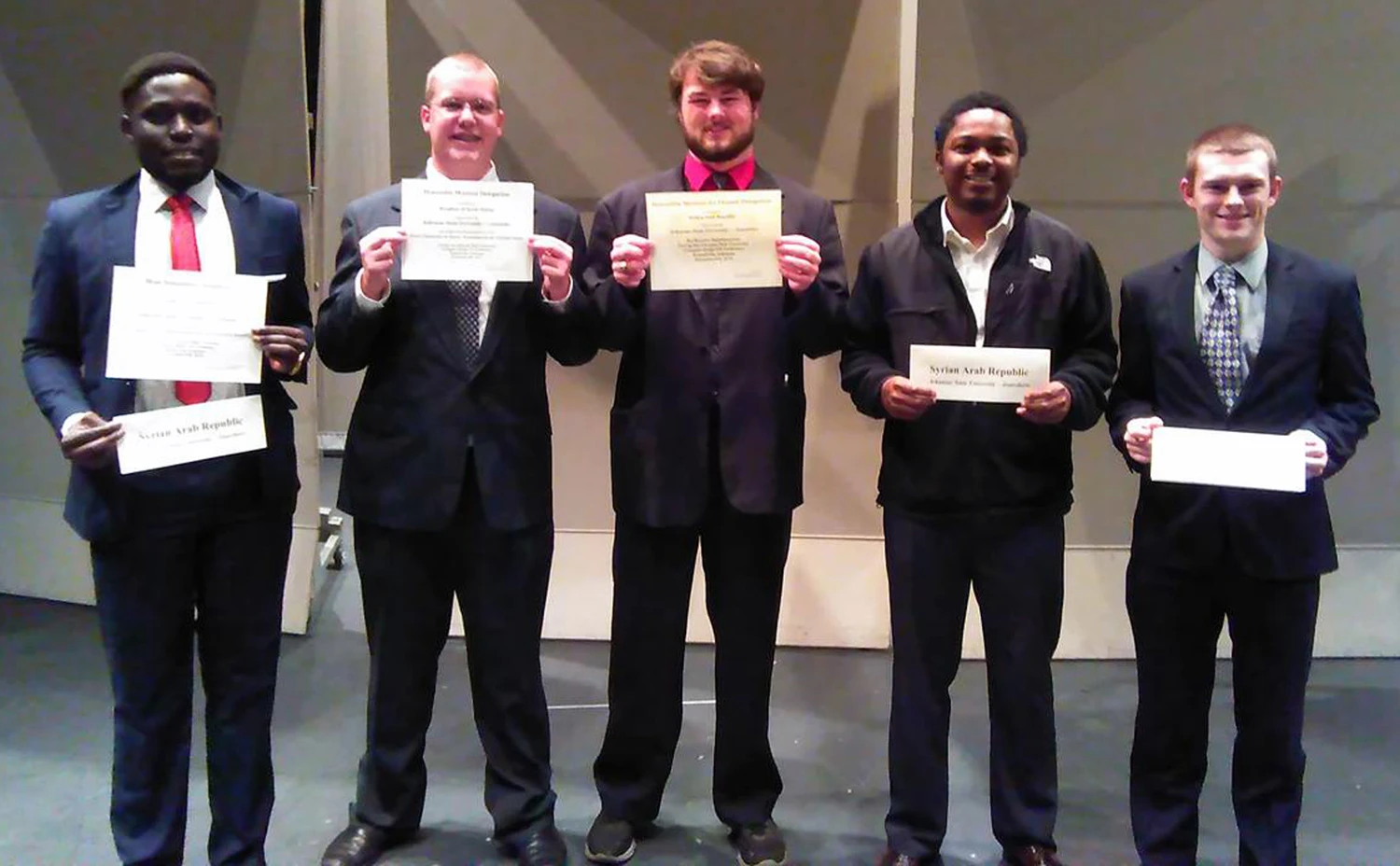
Model United Nations delegation (from left): Anthony Bassey, Philip Cureton, Chase
Newman, Donte Barker and Tim Daley.
“Students must come prepared to discuss their country's position on the issues, listen
to the views of other countries and cooperate with other countries on writing resolutions,”
explained Dr. Jacob Ausderan, assistant professor of political science and faculty
adviser of the group. “The conference was an all-day event. Students worked in their
committees for two and a half hours before breaking for lunch, with another two and
a half hours of committee work afterward.
“For first-time participants, a full slate of committee sessions can be a daunting
experience. This requires—and helps improve—students' negotiation, strategic thinking
and public speaking skills. The students at Arkansas State University were up to the
task, receiving several awards for their efforts, and are already looking forward
to applying what they have learned to the Midwest Model UN Conference in St. Louis
in February 2016.”
The Model United Nations is an educational and academic simulated exercise that places
students in the roles of global leaders and diplomats who attempt to resolve real
world issues. These delegations consisted of three to six members and were assigned
a country to research and represent. The Syrian Arab Republic and the Kingdom of Saudi
Arabia were assigned to the A-State delegation.
“I'm proud of my delegations. Every committee that we participated in we brought home
an award, and I was honored to lead such articulate and skilled delegates to the conference,”
stated Newman who served as the leader of the groups. “Doing well at these conferences
requires knowledge of geopolitics, diplomacy, current events and extensive research
leading up to the conference, and I can say that all of my delegates demonstrated
great tact and ability on all of these topics. They have made me very proud.”
Questions presented to the first committee on disarmament and international security
included, “What can the United Nations do to better respond to the escalation conflict
in and around Syria?” and “What can the UN do to better protect historical and religious
sites during conflicts and wars?”
The second committee on economics and finance were challenged with the questions,
“What can the UN do to better promote sustainable development for landlocked developing
countries?” and “What can the UN do to better promote post-conflict reconstruction
and economic development in countries emerging from revolutions or civil wars?”
And, questions posed to the third committee on social, humanitarian and cultural affairs
were, “What can the UN do to ensure the right to expression when it comes to religion
and religious ideas in the digital age?,” “What can the UN do to alleviate or solve
the worsening Syrian and Middle Eastern refugee crisis?” and “What can the UN do to
better facilitate travel and safety during religious observances?”
All delegations used parliamentary procedures and wrote problem-solving proposals
as they debated the assigned topics. Then, delegation members voted in hopes of enacting
the proposals into law.
Other competing universities were Central Arkansas, Arkansas Tech, Arkansas State-Beebe,
Arkansas-Fayetteville and Arkansas-Monticello.