
Lactation Rooms Now Available in Buildings Across A-State Campus
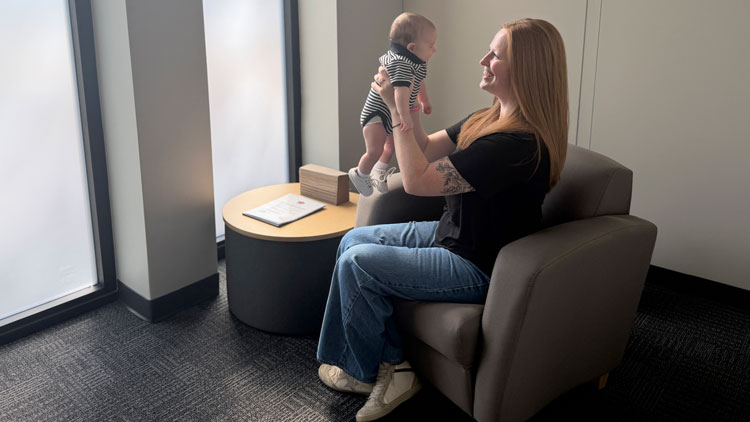
JONESBORO – A new addition at Arkansas State University will make life easier for
nursing mothers. Eight lactation rooms are now available in spaces across campus.
“The need for these spaces really comes down to removing barriers for mothers who
are trying to balance school, work and family,” said Rachel Anderson, director of
social media strategies.
“Nursing and pumping are nonnegotiable, time-sensitive needs, and without a designated
space, mothers are left trying to find somewhere private on their own, pumping or
nursing in their car, or rearranging their day around leaving campus.”
Anderson, who had her second child in June, said this need was a concern for her, and she knew it was also a concern for others on campus.
“This is something that has become especially personal to me,” Anderson added. "As
I returned to work, I knew I would be relying on these spaces across campus. It made
me think about how many other mothers at A-State, including students, faculty, staff
and visitors, are trying to navigate those same needs every day.”
Dr. Tiffany Mosley, director of Institutional Integrity and Title IX, said these rooms
are beneficial to mothers for the health of both themselves and their babies.
“A lactation room is a dedicated private space where nursing mothers can express their
milk through pumping or feeding,” said Mosley. "It is especially useful for mothers
to maintain their milk supply when away from their infant."
Facilitating access to these rooms serves multiple purposes for anyone in need of
the spaces.
“The significance of having a lactation space on campus allows for mothers to maintain
their milk supply while working or attending classes,” Mosley added. “It promotes
academic success and employee retention, and it shows A-State’s support for being
committed to fostering a supportive campus environment for all. Without access to
lactation spaces on campus, mothers risk having medical complications such as clogged
ducts, mastitis or pain and discomfort.”
“A student shouldn't have to choose between attending class and meeting the needs
of her baby, and an employee shouldn't have to choose between doing her job and maintaining
her feeding or pumping schedule,” continued Anderson.
Each room includes a locking door, an electrical outlet, a comfortable chair, and access to a water source nearby.
The rooms are located in the following spaces:
- Room 208 of the Dean B. Ellis Library
- Room 239 of HPESS (Health, Physical Education and Sports Sciences Complex)
- Room 4097 of Humanities and Social Sciences
- Room 3022 of Reng Student Union
- Room 176 of Reynolds Center for Health Sciences
- Rooms 1207 and 1209 in the College of Veterinary Medicine
- Room C030 in Centennial Bank Stadium
These buildings have been recognized as having the highest traffic, including students, employees and visitors. Mosley said they hope to have more spaces added to this list in the future.
The newest space, just in time for the first home football game, located in Centennial
Bank Stadium, is open to anyone who needs to use it while attending athletic events.
This space is right beside entrance W2, which is the main gate into the stadium.
“The private spaces are clean and secure and offer students, employees and visitors
the opportunity to continue breastfeeding while attending class, teaching, working
or participating in activities,” shared Mosley. “Access to lactation spaces allows
mothers to focus on their education and careers while also meeting the needs of their
family.”
Anderson said having these family-friendly additions to campus means there is access
without having to ask for special treatment. Whether someone needs a place to pump,
care for their infant, change a diaper, or care for an older child, there is a growing
number of spaces to take care of the basic needs of those with children.
“I want to be able to come to work or bring my family to an A-State event and know
those needs have already been considered,” she added. “My baby will benefit from the
lactation rooms while I'm working on campus, and my 3-year-old will benefit from family-friendly
facilities when we come to games and events together. These aren't hypothetical families
we're designing for. They're our students, our employees, our visitors, our fans and,
in my case, my own family.”