
Five A-State Students Travel to Dominica in Inaugural Research Trip
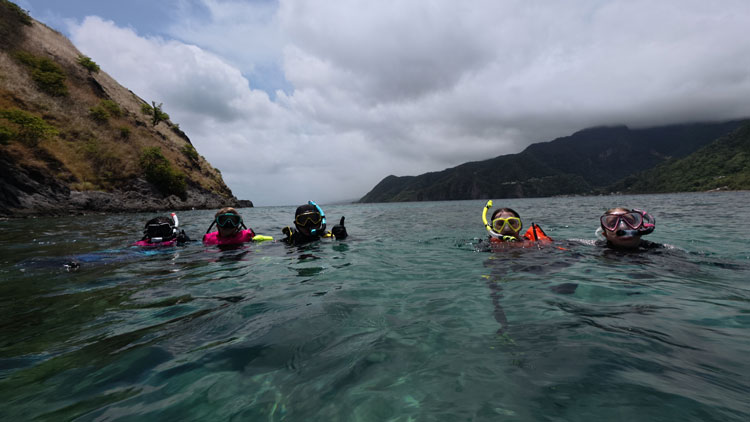
JONESBORO – A group of five students from Arkansas State University returned this
week from a research trip to the Commonwealth of Dominica. Dominica is an independent
country in the Southern Caribbean.
The study abroad trip was the first of its kind for students in their study of environmental
management.
Dr. Jason Post, assistant research professor of geography, led the students in their
research.
Student researchers included Jay Rogers, a master’s in sociology student from Benton,
served as the teacher’s assistant; Saber Brown, a master’s in history student from
Harrisburg; Jessica Harvey, a senior environmental science student from Lawton, Okla.;
Mae Whisenhunt, a sophomore plant and soil science student from Foreman, Ark.; and
Zhoe Davis, a senior animal science student from Marion.
“This pilot program was designed to give students hands-on research experience in
an exciting field location,” Post added. “Many of our students are either in or considering
graduate study, yet have not had the opportunity to participate in field research.”
Post said they hope to make this a recurring program that can grow to include faculty
in various fields of study, including history, agriculture, public health, and biology.
While in Dominica, students worked on two research projects. For the first, a field
mapping and ecology project, students mapped the transition in benthic habitat from
coral to algae along a disturbance gradient to explore the effect of coastal development
on reefs.
“Students conducted this study while snorkeling. Using geographic information systems, the students were able to ground truth previous reef habitat models and compare spatial accuracy of field acquired data to remotely sensed data,” shared Post.
The second research project was a qualitative social science project that focused
on analyzing social media videos and local museum exhibits using open coding and grounded
theory.
“Students looked at how nature and the environment are framed by tourists through
representations of their experiences, how local museums use both colonial and indigenized
perspectives to frame nature on the island, and where tourists interact with nature
on the island.”
Post said taking part in field research trips allows students to apply the knowledge
they have developed at A-State to real-life experiences.
“They become scholars, leaders, project managers, all in one trip. If the students
can get through this, they can accomplish any of the challenges they will face in
their future careers. Fieldwork teaches attention to detail, determination and perseverance
in the face of adversity, grit and self-confidence, teamwork, and communication,”
Post said.
Many of the students did not have international travel experience, and this opportunity
not only strengthened their research abilities, but also gave them cultural experience.
“We are in a highly globalized society. Cultural competence and travel experiences
are highly sought after by employers,” continued Post. “This program is as much about
research as it is about development of the whole student — the whole person. They
will bring back new experiences, skills, and confidence that will help them return
to campus as leaders.”
He said students will present their findings in a formal public symposium at 3 p.m.
on Friday, June 26. Many plan to continue this work in support of peer-reviewed publications.
This trip also opens the doors for future endeavors.
“This served as proof of concept. We hope to be able to invite students from Dominica
to A-State in the future,” said Post. “This program allowed us to conduct pilot studies
that may hopefully be used to secure future funding so we can continue this work.”