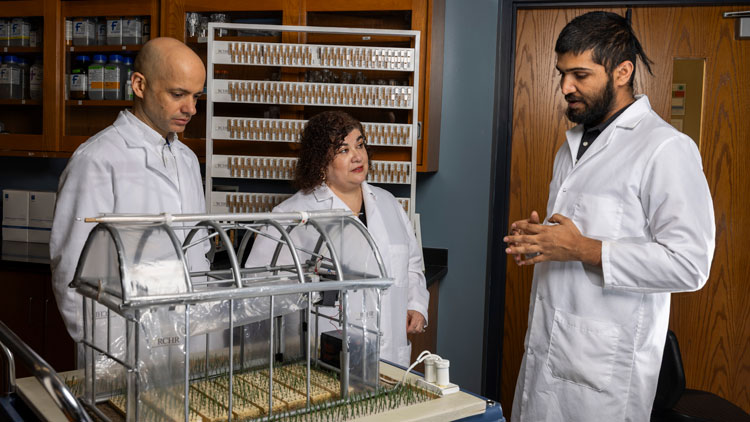
A-State Researchers Use DNA 'Barcodes' to Verify Medicinal Plants
JONESBORO – Herbal remedies are used by millions of people around the world, but how can a buyer be sure the plant in the package is the one on the label? New research from Arkansas State University offers a reliable answer.
Dr. Argelia Lorence, professor of metabolic engineering in the Department of Chemistry and Physics, and Dr. Reinier Gesto-Borroto, manager of the phenomics core at the Arkansas Biosciences Institute (ABI), published their findings in the journal Ethnobotany and Economic Botany. The article is titled “DNA Barcoding Validation of Medicinal Ipomoea Species from the Morning Glory Family.”
Lorence shares corresponding authorship of the study with Dr. Rogelio Pereda-Miranda of the Faculty of Chemistry at the National Autonomous University of Mexico (UNAM). Pereda-Miranda is one of the world’s foremost authorities on Ipomoea and has devoted his career to studying the chemistry of the species that grow in Mexico, Brazil and, more recently, the United States. The new paper grows out of a scientific partnership between Lorence and Pereda-Miranda that began in 1998, and it reflects nearly three decades of shared work across borders.
Morning glories belong to the Ipomoea group of plants, which has approximately 800 species around the world. Many have long been used in traditional medicine, especially in Mexico, where remedies made from these plants go back centuries. Because several species look alike, they are easy to confuse once they are dried, ground or packaged as seeds.
The team tested commercially sold seeds from five Ipomoea species and one hybrid using DNA barcoding. This method reads short, distinctive stretches of a plant’s genetic code, much like a store scanner reads a product barcode. The tests found that seeds sold under two different names were in fact the same species. The finding shows that labels alone cannot always be trusted.
“I am very proud of this work that is the product of the longstanding collaboration between my team and Dr. Pereda-Miranda’s group,” said Lorence.
The study also identified which DNA markers work best for telling these medicinal species apart. That gives regulators and producers a practical tool for quality control. The authors note that DNA testing works best alongside traditional plant expertise, careful record-keeping and respect for the Indigenous knowledge behind these remedies.
“It has been rewarding to be part of this research, which highlights the importance of accurate plant identification to improve the quality and safety of herbal products,” said Gesto-Borroto.
The research team also included Dr. Karina Medina-Jiménez of ABI, Dr. Adriana Carolina Hernández-Rojas of UNAM and Dr. María Crystal Columba-Palomares of the Autonomous University of the State of Morelos, who visited the Lorence Laboratory as a Fulbright scholar. The authors suggest that future work could add chemical testing to measure each plant’s active compounds, providing a fuller picture of herbal product quality and safety.
The full article is available online for viewing.