
A-State Leads $2.2M NSF Project on Drought-Resilient Rice, Wheat
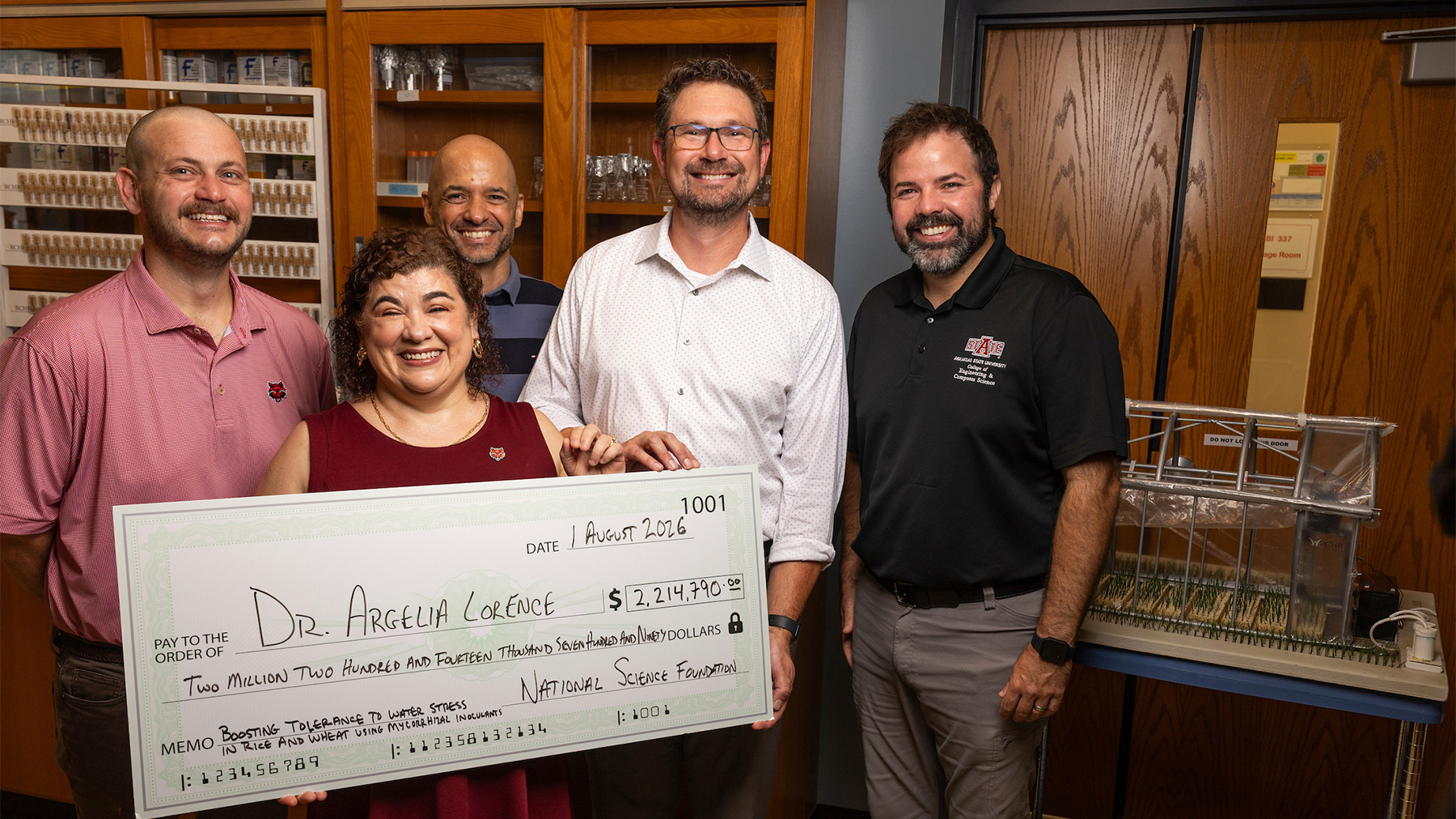
JONESBORO – Arkansas State University has received a $2.2 million award from the National Science Foundation (NSF) to lead a multi-institutional research project to improve drought tolerance in rice and wheat, two of the world's most important food crops.
The project, “Collaborative Research: FEC: Boosting Tolerance to Water Stress in Rice and Wheat Using Mycorrhizal Inoculants,” is funded through the NSF Established Program to Stimulate Competitive Research (EPSCoR) Research Infrastructure Improvement: Focused EPSCoR Collaborations (RII-FEC) program.
Dr. Argelia Lorence, professor of metabolic engineering, leads the research, with Dr. Scott A. Mangan, associate professor of ecology, serving as co-principal investigator. A-State is collaborating with the University of Kansas, the University of Nebraska, and Kansas State University on the four-year project.
With drought conditions being an issue across agricultural regions, the research team will investigate how naturally beneficial soil fungi, known as arbuscular mycorrhizal (AM) fungi, can help rice and wheat better withstand water stress.
“In this grant we seek to develop strategies to boost the tolerance to water stress in rice and wheat using mycorrhizal fungal inoculants. With droughts becoming more common and severe, developing strategies to keep growing rice with less water is important and the reason why this study is significant,” said Lorence. Mycorrhizal fungi form symbiotic relationships with plant roots, enhancing nutrient uptake, water absorption, and overall plant growth.
The project combines plant biology, ecology, physiology, genomics and field research to better understand how plants respond to drought. In addition, researchers will examine the socioeconomic factors that influence farmers' adoption of fungal inoculant technologies.
"A-State is leading a complex $6M total award across three states and four universities addressing applied research to improve rice and wheat crop yields," noted Dr. Travis Marsico, vice provost for research, innovation and discovery. "Through this project, Dr. Lorence and her team demonstrate collaborative leadership on a topic important to Arkansans. This is what we do at A-State . . . make important, relevant discoveries that move us forward."
Beyond advancing agricultural research, the award will support undergraduate and graduate student training, workforce development, and educational outreach across Arkansas and partner institutions.
The project began Aug. 1 and continues through July 31, 2030, demonstrating A-State's leadership in agricultural innovation and collaborative research that addresses real-world challenges in food security and sustainable agriculture.